
Home · Recipes & Guides · Field guide
Parts of the Dabberlocks (Badderlocks)
Holdfast to sporophyll: what to take, what to leave, and why.
By Jayson Byles, forager & chef · Updated August 2026
Dabberlocks, also spelled badderlocks and in older Scots honeyware (Alaria esculenta, also known as winged kelp or Atlantic wakame), is a kelp of the exposed lower shore, identified by the pale midrib running the full length of its single olive blade. It has distinct parts, and knowing them is the difference between harvesting well and harming the plant. The plants grow individually or clustered together on rock, each anchored by its own holdfast.
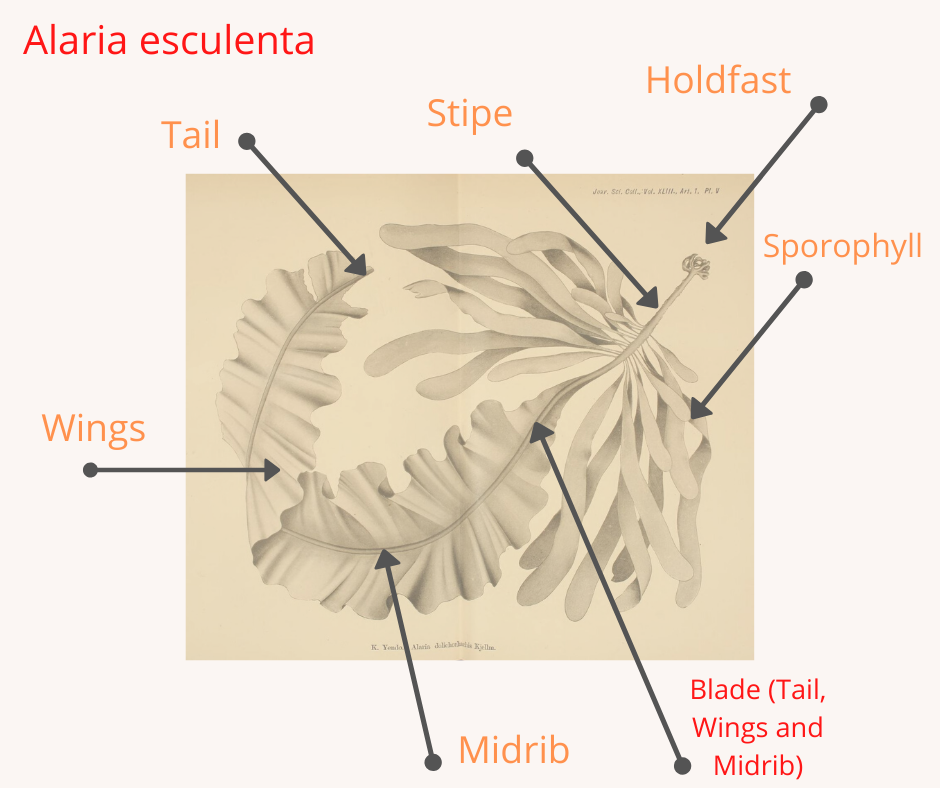
The parts that matter
- Holdfast: the root-like anchor gripping the rock. Never take it; without it the plant is gone for good.
- Stipe and midrib: the tough spine running the length of the blade. Fine chopped small, or dried.
- Blade (the wings): the tender olive wings either side of the midrib: the best eating, fresh or dried, and the star of our dabberlocks pickle.
- Sporophylls: the small paddle-shaped fronds at the base. These carry next season’s spores.

How do you identify dabberlocks?
The midrib settles it: no other British kelp carries a distinct pale rib running the full length of the blade. The blade is long, up to two metres, olive to golden, with tender “wings” either side of the rib and paddle-shaped sporophylls clustered at the base. It holds to exposed, wave-washed rock at the lowest tides, exactly where sugar kelp (crinkled, no midrib) will not sit. Our hand-drawn plate in the field guide shows the cut line.
Is dabberlocks the same as badderlocks?
Yes: dabberlocks and badderlocks are the same seaweed, Alaria esculenta, also called winged kelp, Atlantic wakame and, in older Scots, honeyware. The spelling varies around the Scottish coast; the plant does not.
What does dabberlocks taste like?
Tender and nutty with a clean sweetness: the closest British texture to Japanese wakame, which is its cousin. The wings eat well raw in a salad, dried as crisps, or pickled: our ginger, carrot & chilli pickle is built on it. The midrib, chopped fine or dried, brings the crunch.
Harvesting for next year
Make a clean cut 30 cm (about 12 inches) above the sporophyll and leave the sporophyll intact to ensure next season’s harvest. Be selective: fully mature blades grow up to 2 metres long and 15cm wide, so just a few blades are needed for a good meal. This is the “cut, never pull” principle in action.
Seventeen seconds of the real thing: Jayson cutting a dabberlocks blade approximately 30 cm (12 inches) above the sporophylls. One clean cut, and the holdfast and sporophylls stay on the rock for next year.